

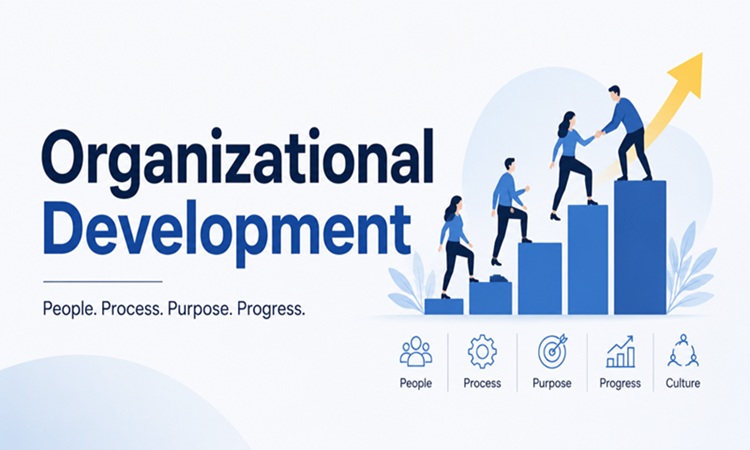
Every organization changes over time. The question isn’t whether change will happen — it’s whether it happens deliberately or by default. Organizational development is the discipline that answers that question with intention.
It’s a field that sits at the intersection of business strategy, behavioral science, and change management. And despite the fact that it gets discussed primarily in HR and leadership circles, its impact reaches every corner of how a business operates — from how decisions get made to how people are developed to whether a company remains capable of adapting as its environment shifts.
Defining Organizational Development
Organizational development — commonly abbreviated as OD — is a planned, systematic approach to improving an organization’s effectiveness and health. It draws on behavioral science research to help organizations build the capacity to change, solve problems, and grow in ways that serve both the business and the people who make it up.
That last part matters. OD differs from straightforward restructuring or efficiency programs in its explicit attention to human dynamics — how people experience their work, how teams function, how culture shapes behavior, and how change affects the people going through it. An organization that improves its financial performance by burning out its workforce has not achieved organizational development. It has traded long-term health for short-term output.
The field emerged formally in the 1950s and 1960s, drawing heavily on the work of Kurt Lewin — whose research on group dynamics, planned change, and the relationship between behavior and environment laid the conceptual foundation that most OD practice still builds on.
What Organizational Development Actually Addresses
OD interventions — the structured activities that practitioners use to improve organizational functioning — cover a wide range of issues. Understanding the breadth of what OD addresses helps clarify why it’s more than a rebranded HR function.
Culture and climate. Organizational culture — the shared assumptions, values, and behavioral norms that shape how work gets done — is one of the most powerful and least visible forces in any organization. OD work in this area involves diagnosing the current culture honestly, understanding the gap between the culture that exists and the one the organization needs, and designing interventions that shift norms and behaviors over time. This is slow work, and it resists shortcuts.
Leadership development. Developing the capabilities of leaders at every level — not just senior executives — is a core OD concern. This goes beyond training programs to include coaching, structured feedback mechanisms, leadership team effectiveness work, and the organizational conditions that either support or undermine good leadership.
Team effectiveness. How teams are structured, how they make decisions, how they manage conflict, and how clearly their purpose is defined all affect their performance significantly. OD practitioners work with teams to diagnose dysfunction, clarify roles and norms, and build the relational foundation that high-performing collaboration requires.
Change management. Organizations face constant pressure to adapt — to market shifts, competitive threats, technological change, regulatory requirements, and strategic pivots. Managing these transitions in ways that maintain organizational functioning and retain employee engagement is one of the most practically demanding areas of OD work.
Organizational design. How an organization is structured — its reporting relationships, its division of responsibilities, its governance mechanisms — shapes behavior and performance in ways that aren’t always visible until something goes wrong. OD work in this area involves designing structures that enable the organization’s strategy rather than creating friction against it.
The OD Process: How It Works in Practice
Organizational development follows a broadly consistent process regardless of the specific intervention, often described through the action research model that Lewin and his colleagues developed.
It begins with diagnosis — a systematic effort to understand the current state of the organization: what’s working, what isn’t, and why. This involves data collection through surveys, interviews, observation, and review of organizational metrics. Effective diagnosis resists the temptation to assume the presenting problem is the real problem. Surface-level symptoms — high turnover, declining engagement, poor cross-functional collaboration — are almost always expressions of deeper organizational dynamics.
From diagnosis, OD work moves to feedback and planning — sharing findings with the organization in ways that create shared understanding of the current state and build collective commitment to change. This step is where many change initiatives fail. Organizations that skip genuine feedback and jump straight to solution implementation typically find that the solutions don’t stick, because the people expected to change their behavior were never part of diagnosing the problem.
Implementation follows — the actual interventions designed to move the organization from its current state toward a more effective one. These might include structural changes, new management practices, team development activities, leadership coaching, process redesign, or cultural initiatives.
Evaluation closes the cycle — assessing whether the interventions produced the intended outcomes, what worked and what didn’t, and what the next round of improvement requires. Effective OD is iterative rather than episodic. Organizations that treat it as a one-time project rather than an ongoing discipline tend to see improvements erode over time as old patterns reassert themselves.
OD vs. Change Management: Understanding the Difference
The terms organizational development and change management are often used interchangeably in practice, but they describe related and distinct things.
Change management typically refers to the structured process of transitioning an organization from a specific current state to a defined future state — implementing a new system, restructuring a function, integrating an acquisition. It’s largely project-oriented, with a defined beginning, middle, and end.
Organizational development is broader in scope and longer in time horizon. It’s concerned with building the organization’s overall capacity to function effectively and adapt over time — not just managing a specific transition. Change management sits within OD as one of its important applications, but OD encompasses much more than managing discrete change events.
Why OD Matters More in Uncertain Environments
The conditions that make organizational development particularly valuable are precisely the conditions that characterize most markets today: rapid change, increasing complexity, workforce expectations that are shifting significantly, and competitive pressures that reward adaptability over stability.
Organizations that invest in their own effectiveness — in the quality of their leadership, the health of their culture, the clarity of their structure, and the capability of their people — tend to navigate uncertainty more effectively than those that treat these dimensions as secondary to financial and operational performance.
Research consistently supports this. Organizations rated highly on employee experience and cultural health tend to outperform their peers on financial metrics over time, not because culture causes financial performance directly, but because the same conditions that produce a healthy culture — clear purpose, strong leadership, psychological safety, effective collaboration — also produce better decisions, better execution, and better retention of capable people.
The Practitioners Behind OD Work
Organizational development is practiced by both internal specialists — OD professionals employed within organizations, often sitting within HR or People functions — and external consultants brought in for specific diagnostic or change work.
The most credible professional body in the field is the Organization Development Network, which represents OD practitioners globally, publishes research and practitioner resources, and maintains professional standards for the discipline. For organizations trying to understand what effective OD practice looks like and how to evaluate practitioners, it’s the most reliable starting point in the field.
The Honest Complexity
Organizational development is not a precise science, and practitioners who claim otherwise are overstating what the field can deliver. Organizations are complex human systems, and interventions that work well in one context don’t always transfer cleanly to another. Culture change is slow. Leadership development is non-linear. The relationship between an OD intervention and a business outcome is often indirect and difficult to isolate.
What OD offers is not a guarantee of specific outcomes but a disciplined, evidence-informed approach to improving the conditions under which good outcomes become more likely. That’s a more modest claim than some consulting pitches make — and a more honest one.
The Core Insight
At its foundation, organizational development rests on a straightforward premise: organizations are more effective when the people in them are more effective, and the conditions under which people work — their culture, their leadership, their structures, and their relationships — are not fixed. They can be diagnosed, understood, and deliberately improved.
That premise has held up across six decades of research and practice. In an environment where organizational adaptability is increasingly the primary source of competitive advantage, it’s more relevant now than when Lewin first articulated it.
