

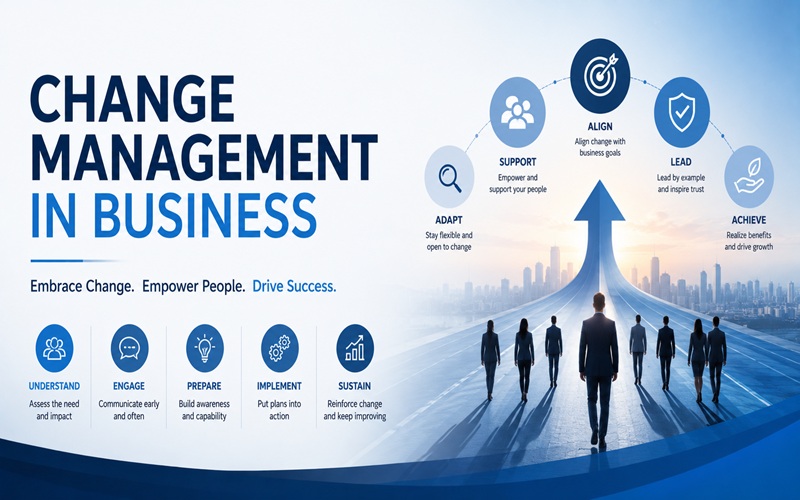
Organizations change constantly. New technology gets implemented. Processes get redesigned. Teams get restructured. Leadership changes. Markets shift and strategies respond. The list of things that require people to work differently than they worked before is essentially endless in any active organization.
Most of these changes fail to produce the outcomes they were designed to achieve, not because the change itself was wrong but because of how it was implemented. The initiative that made perfect sense on a strategy document encountered the reality of human behavior, organizational culture, and the deeply embedded habits of how work actually gets done, and produced less than expected or nothing at all.
Change management is the discipline that addresses this gap. It’s the structured approach to transitioning individuals, teams, and organizations from their current state to a desired future state in a way that minimizes resistance, maximizes adoption, and produces the outcomes that justified the change in the first place.
Why Change Fails Without Management
The statistics on organizational change failure have been cited so often that they’ve become almost clichéd, but the underlying reality they describe is genuine. Research from McKinsey, Harvard Business Review, and other credible sources consistently finds that somewhere between 50 and 70 percent of major organizational change initiatives fail to achieve their intended objectives.
The reasons for this failure cluster around a consistent set of root causes that have been identified across decades of research.
Leadership behavior that doesn’t model the change undermines it at the most visible level. When senior leaders communicate the importance of a new way of working and then visibly continue working the old way, the message received by the organization is that the change doesn’t apply to those with enough authority to avoid it. This signal travels fast and produces the cynicism that makes subsequent change efforts harder regardless of their merit.
Insufficient communication about the reasons for change, what it will require from people, and what they can expect through the transition creates the anxiety and speculation that fill the vacuum of silence. People don’t resist change because they’re irrational. They resist it when they don’t understand why it’s happening, don’t trust that it will be handled well, or don’t believe they’ll be able to succeed in the new state. Communication that addresses these concerns directly and repeatedly is the primary antidote to resistance driven by uncertainty.
Underestimating the human side of change treats implementation as primarily a technical or project management challenge. Installing new software, redesigning a process, and restructuring a team are technical activities. Getting the people who use the software, execute the process, and work within the team to actually change how they work is a human activity that requires different skills and different approaches than technical implementation.
Insufficient time for adoption mistakes the completion of implementation activities for the achievement of change outcomes. A system can be installed, a process can be documented, and a structure can be announced in a fraction of the time it takes for the people affected to genuinely change their behavior. Organizations that declare victory when the technical implementation is complete and reduce change support before genuine adoption has occurred typically find that old behaviors reassert themselves and the change produces far less value than intended.
The Core Components of Change Management
Change management as a professional discipline has developed structured approaches to these challenges that, when applied with appropriate judgment, meaningfully improve the probability of successful change outcomes.
Stakeholder Analysis and Engagement
Not everyone in an organization is equally affected by a given change, and not everyone has equal power to support or undermine it. Stakeholder analysis maps who will be affected by the change, how significantly, and in what ways, and identifies the individuals and groups whose active support is essential versus whose passive acceptance is sufficient.
This analysis shapes the engagement strategy. Key stakeholders who are skeptical or resistant require direct engagement, genuine listening to their concerns, and visible responsiveness to those concerns where they’re legitimate. Influential informal leaders who aren’t in the formal hierarchy but who shape opinion and behavior among their peers deserve attention disproportionate to their formal position. Groups whose commitment will determine whether the change takes hold need more investment than those whose behavior is less consequential.
Leadership Alignment
The coalition of leaders who need to be visibly aligned with the change and consistent in their messaging about it is the most important factor in large-scale change initiatives. When senior leaders contradict each other, send mixed signals about commitment, or demonstrate through their own behavior that the change is optional, the organization reads those signals accurately and responds accordingly.
Building leadership alignment before the change is communicated to the broader organization requires honest conversations among leaders about their genuine concerns, the resolution of disagreements about the change’s direction and approach, and explicit agreements about how to communicate consistently even when there are legitimate differences of view. Leaders who have unresolved concerns about a change they’re being asked to champion communicate those concerns nonverbally in ways that undermine the message regardless of their verbal compliance.
Communication Planning
Communication for organizational change is not the same as information distribution. The distinction matters practically. Effective change communication addresses the emotional and human aspects of the change alongside the rational and informational ones, creates genuine two-way dialogue rather than one-way broadcasting, and continues through the implementation and into the stabilization phase rather than concentrating at the announcement.
The communications that produce the best change outcomes answer the questions that affected people actually have rather than the questions that leadership thinks they should have. What does this mean for me specifically? Why is this happening now? What will be different about how I work? What support will I have? What happens to people who struggle with the transition? What happens to people who don’t adapt? These questions are rarely addressed in the corporate communications that accompany change announcements, and the gap between what’s communicated and what people need to understand creates the anxiety that fuels resistance.
Training and Capability Development
People can’t adopt a new way of working if they don’t know how to work that way. Training is the component of change management that builds the specific skills and knowledge required to perform in the changed state. Its absence is among the most common causes of change failure because organizations often implement changes that require new capabilities without providing the development needed to build them.
Effective training for organizational change is designed around the actual performance requirements of the changed state rather than the features of the new system or process. It addresses not just what to do but how to do it in the specific context of the learner’s role, and it’s timed to be proximate to the moment when the learner needs to apply it rather than weeks before the change is activated.
Resistance Management
Resistance to organizational change is a normal human response rather than an organizational pathology. The instinct to protect established patterns of work, relationships, and identity against disruption is understandable and, in some cases, signals that the resistance contains legitimate information about problems with the change that proponents need to hear.
Effective resistance management distinguishes between resistance driven by legitimate concerns that should change the implementation approach and resistance driven by anxiety, misunderstanding, or self-interest that requires different responses. Dismissing all resistance as obstruction loses the signal in the noise. Treating all resistance as valid feedback paralyzes change programs. The judgment about which is which requires genuine engagement with the sources of resistance rather than assumptions about their nature.
Reinforcement and Sustainability
The phase of change management that most organizations underinvest in is the reinforcement that occurs after the change has been implemented but before new behaviors have fully stabilized. The period immediately following technical implementation is when old behaviors are most likely to reassert themselves, when the support structures that enabled the transition are being withdrawn, and when the organization’s attention has moved to the next initiative.
Reinforcement mechanisms including measurement of adoption, visible recognition of people who are performing well in the new state, and consistent accountability for behaviors that contradict the change direction signal that the organization’s commitment to the change is durable rather than episodic. Without these mechanisms, the investment in the change itself produces diminishing returns as behaviors revert to the familiar patterns they replaced.
The Major Change Management Frameworks
Several structured frameworks have been developed that provide practitioners with systematic approaches to managing organizational change. Understanding the major ones helps select the approach most appropriate to the specific context.
Prosci’s ADKAR Model
ADKAR is an acronym for Awareness, Desire, Knowledge, Ability, and Reinforcement, representing the five sequential building blocks that an individual must achieve to successfully adopt a change. The model posits that change succeeds at the organizational level only when it succeeds at the individual level, and that each individual must progress through all five building blocks in sequence.
Awareness that the change is happening and why it’s necessary is the first requirement. Without awareness, nothing else is possible. Desire to support and participate in the change must follow awareness, because awareness alone doesn’t produce engagement. Knowledge of how to change, the skills and behaviors required in the new state, must be developed for desire to translate into action. Ability to implement the new behaviors requires that the knowledge be applied in practice, with support and feedback that develop genuine capability rather than theoretical understanding. Reinforcement sustains the change by creating conditions that make reverting to old behaviors less attractive than maintaining the new ones.
ADKAR’s value is that it provides a diagnostic framework as well as a planning framework. When a change is failing, the ADKAR model helps identify where in the sequence the breakdown is occurring, which guides the corrective intervention. An organization where people are aware of the change but don’t desire it has a different problem than one where people desire the change but lack the knowledge to execute it.
Kotter’s 8-Step Model
John Kotter’s eight-step model for leading change, developed from research on why major change initiatives succeed or fail, provides an organizational-level framework for sequencing change activities. The steps are creating a sense of urgency, building a guiding coalition, forming a strategic vision, enlisting a volunteer army, enabling action by removing barriers, generating short-term wins, sustaining acceleration, and instituting change.
The model’s most influential insight is the emphasis on creating genuine urgency rather than assuming that the case for change is self-evident to everyone who will be affected by it. Changes that seem obviously necessary to their architects often don’t feel urgent to the people who will need to change their behavior, and building the shared understanding of why the status quo is inadequate is the first prerequisite of successful change.
The guiding coalition concept reflects the reality that change led by a single champion, however senior, is more fragile than change led by a diverse coalition of people with credibility across different parts of the organization. Building that coalition before the change is launched creates the distributed leadership that can sustain momentum when the change encounters the inevitable obstacles and setbacks.
McKinsey’s 7-S Framework
McKinsey’s 7-S Framework, developed by Tom Peters and Robert Waterman in the early 1980s, provides a lens for understanding organizational change in terms of seven interconnected elements: strategy, structure, systems, shared values, skills, style, and staff. The framework’s central insight is that these seven elements are interdependent and that changing one without considering its effects on the others produces unintended consequences that undermine the change.
A strategy change that isn’t supported by matching changes to the structure, systems, and skills required to execute it is a strategy on paper that the organization isn’t actually capable of implementing. A structural change that doesn’t account for the cultural values that drive behavior creates a new org chart that people navigate according to the old logic. The 7-S framework prompts change leaders to consider the full system of organizational elements affected by a change rather than optimizing a single element in isolation.
Change Management vs. Project Management
Change management and project management are distinct disciplines that are both required for major organizational changes, and the failure to understand the difference leads organizations to treat change initiatives as purely project management challenges.
Project management addresses the technical dimension of change: the activities, timelines, resources, and deliverables that constitute the implementation. A technology implementation managed as a project has work packages, milestones, dependencies, budgets, and completion criteria that define when the project is done.
Change management addresses the human dimension of change: the transition of the people affected by the implementation from their current ways of working to the new ways required by the change. The project is done when the system is installed. The change is done when the people using the system are working in the new ways the system was designed to enable.
The distinction between these two completion definitions explains why so many technically successful project implementations fail to produce business outcomes. The project delivered what it promised. The change management didn’t ensure that people actually adopted the new way of working that the project enabled.
Effective organizational change requires both disciplines operating in parallel with explicit coordination between them. The project plan and the change management plan need to be integrated, with dependencies in both directions recognized and managed. The technical implementation timeline needs to account for the change management activities that must precede it, and the change management activities need to be sequenced to the technical implementation milestones that trigger them.
Change Management at Different Scales
The appropriate change management approach varies significantly with the scale and nature of the change, and one of the most common mistakes in change management is applying an enterprise-scale approach to a small change or applying an inadequate approach to a large one.
Small-scale changes affecting a single team or process within a stable organizational context require lighter-touch change management that focuses primarily on clear communication, adequate training, and direct engagement with the people affected. Applying the full apparatus of a formal change management methodology to a process update that affects twenty people and doesn’t require new technology creates overhead that exceeds the value of the change.
Large-scale transformations affecting multiple business units, requiring new capabilities across the workforce, changing the fundamental way the organization delivers value, or requiring significant cultural change need the full rigor of a structured change management approach. These are the changes where the gap between having and not having mature change management capability determines whether the transformation produces its intended value.
The judgment about which scale of approach is appropriate requires honest assessment of the change’s impact on people rather than the change’s technical complexity or cost. A large technology investment that most people will experience as a minor adjustment to their daily workflow needs less change management than a modest process change that requires people to abandon deeply established habits and relationship patterns.
Change Management as Organizational Capability
The most sophisticated organizations treat change management not as a service provided to specific initiatives but as an organizational capability that is built and maintained over time. An organization with mature change management capability deploys it efficiently to changes of appropriate scale, builds it into how projects are structured and resourced from the outset, and develops the leadership behaviors and cultural norms that make change adoption faster and less disruptive over time.
Building this capability requires investment in the professional development of change management practitioners, in the tools and methodologies that structure change management work consistently, and in the leadership development that ensures senior leaders have the skills and inclination to sponsor changes effectively rather than leaving change management to practitioners without executive engagement.
The Association of Change Management Professionals is the primary professional body for change management practitioners globally, providing the Certified Change Management Professional credential, professional standards through its Standard for Change Management, and a community of practitioners that represents the professional reference point for the discipline.
The Practical Starting Point
For organizations that recognize they need better change management capability but are starting from a low base, several practical starting points produce improvement without requiring the full build-out of a mature change management function.
Ensuring that every significant change initiative has an explicitly designated change lead who is accountable for the human adoption dimension of the change, separate from the project manager accountable for the technical implementation, creates the basic accountability structure that most struggling change efforts lack.
Conducting a stakeholder analysis and developing a communication plan before any change is announced rather than after establishes the foundation that all subsequent change activities build on, and costs far less than remediation after resistant stakeholders have organized against the change.
Building leadership alignment and addressing leadership concerns about the change before communication to the broader organization prevents the mixed messages that undermine change initiatives at the most visible level.
Treating testing and exercises as investments in change adoption rather than compliance activities builds the organizational experience base that makes subsequent changes faster and more effective.
None of these requires a certified change management function or a formal methodology. They require the recognition that people are the most important variable in whether organizational changes produce their intended outcomes, and the deliberate management of the human dimension of change with the same rigor applied to its technical and project dimensions.
