

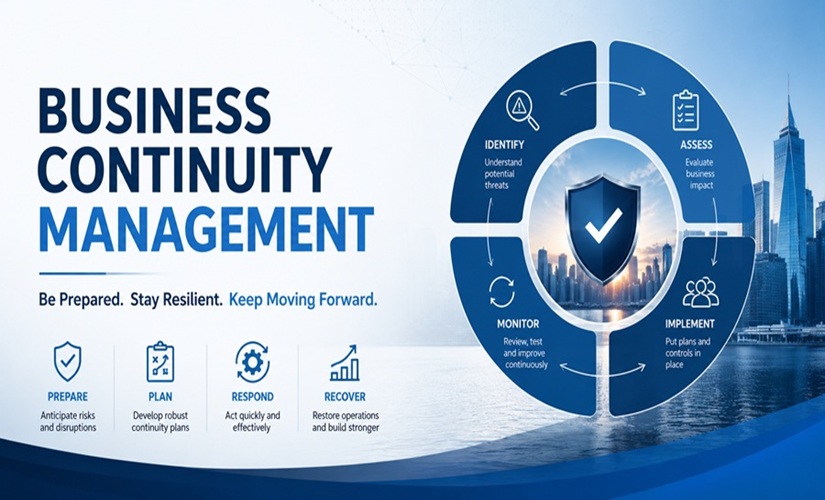
Business continuity management gets discussed in serious organizations and ignored in most others. The serious ones have learned, usually through experience, that the gap between a disruption that ends as an inconvenience and one that ends the business is almost entirely determined by whether the organization had a functioning continuity management program before the disruption arrived.
The ignored version of business continuity management sits in a folder somewhere as a document that was produced to satisfy an auditor or an insurance requirement and has never been tested, updated, or used in an actual emergency. This version provides false comfort rather than genuine resilience.
Understanding what business continuity management actually is, what a functional program covers, and what distinguishes genuine capability from documentation theater is the starting point for building something that works.
The Core Definition
Business continuity management, commonly abbreviated BCM, is the discipline through which an organization identifies threats to its operations, assesses the impact of those threats on its ability to deliver its products and services, and develops the capability to respond to and recover from disruptions in a way that protects its stakeholders, reputation, and commercial interests.
The International Organization for Standardization defines business continuity management through ISO 22301, the international standard for BCM, as a holistic management process that identifies potential threats to an organization and the impacts to business operations that those threats, if realized, might cause, and which provides a framework for building organizational resilience with the capability for an effective response that safeguards the interests of its key stakeholders, reputation, brand, and value-creating activities.
That definition captures the essential components: it’s a management process rather than a one-time project, it addresses threats proactively rather than reactively, it focuses on impact on operations rather than threats in isolation, and its purpose is organizational resilience rather than merely crisis documentation.
What BCM Is Not
The boundaries of BCM are as important as its definition, because confusion about what the discipline covers leads to gaps in organizational resilience that only become visible when they matter most.
Business continuity management is not the same as disaster recovery, though the two are closely related and often confused. Disaster recovery is a subset of BCM that specifically addresses the restoration of IT systems and technology infrastructure following a disruption. BCM addresses the broader question of how the entire organization continues to operate during and after disruption, of which technology recovery is one important component.
Business continuity management is not crisis management, though crisis management is part of a complete organizational resilience framework. Crisis management addresses the immediate response to a disruptive event, including the decisions made in the first hours and days. BCM addresses the longer-term continuation and recovery of business operations, which begins where crisis management ends.
Business continuity management is not risk management, though BCM depends on risk management analysis. Risk management identifies and assesses threats and determines responses including avoidance, mitigation, transfer, and acceptance. BCM builds the operational capability to continue functioning when risks materialize despite risk management controls.
Business continuity management is not a compliance exercise, though many organizations first develop BCM programs in response to regulatory requirements. The distinction matters because compliance-driven programs often stop at documentation rather than building genuine operational capability. A BCM program that satisfies regulators but hasn’t been tested against realistic scenarios provides a false sense of security that may be worse than acknowledged vulnerability.
The Business Impact Analysis: The Foundation of Everything Else
The business impact analysis is the analytical process that provides the factual foundation for all other BCM activities. Without a well-executed BIA, continuity planning is based on assumptions rather than evidence, and the plans produced reflect what planners think matters rather than what actually matters.
The BIA identifies the organization’s critical business functions, the processes, activities, and resources that must continue or be recovered within defined timeframes for the organization to survive and meet its obligations. Not every function is critical in this sense. Some can be suspended for days or weeks without material impact. Others can tolerate only minutes or hours of interruption before the consequences become severe.
The BIA establishes two key metrics for each critical function. The Maximum Tolerable Period of Disruption is the longest period of time that a function can be interrupted before the consequences become unacceptable from the perspectives of financial impact, regulatory obligation, reputational damage, and contractual commitment. The Recovery Time Objective is the target time within which the function must be restored following a disruption, set at a level that ensures recovery occurs before the MTPD is reached.
The BIA also establishes the Recovery Point Objective for data-dependent functions, defining the maximum amount of data loss that is acceptable measured in time. A function with an RPO of four hours means that data must be recoverable to a point no more than four hours before the disruption, which drives the backup frequency required to support that recovery capability.
The BIA process requires genuine engagement with the people who perform critical functions rather than assumptions made at a management level about what matters. The operational reality of which functions depend on which systems, which staff, which suppliers, and which physical locations is often different from what senior management believes, and the BIA is the mechanism for discovering those dependencies accurately.
The Components of a BCM Program
A mature BCM program consists of several interconnected components that work together to produce organizational resilience rather than isolated plans for specific scenarios.
The BCM policy establishes the organizational commitment to business continuity, defines the scope of the program, assigns accountability for its development and maintenance, and sets the standards against which the program will be assessed. Without a policy that has genuine executive endorsement and clear accountability, the BCM program becomes an optional activity rather than an organizational requirement.
Business continuity strategies translate the findings of the BIA into the approaches the organization will use to ensure critical functions can continue or be recovered within their defined timeframes. Strategies address four types of resource dependencies: people, premises, technology, and supply chain and third parties. For each dependency, the strategy defines the alternative arrangements that will be activated when the primary arrangement is unavailable.
People strategies address the scenario where key personnel are unavailable due to illness, travel disruption, or other causes. Cross-training, documented knowledge transfer, succession arrangements, and reserve staffing pools all represent people strategies that reduce the organization’s vulnerability to individual absences.
Premises strategies address the scenario where primary work locations are inaccessible or unusable. Remote working arrangements, alternate work sites, reciprocal arrangements with other organizations, and work area recovery services all represent premises strategies. The COVID-19 pandemic demonstrated that organizations with pre-established remote working capability recovered from the shift to mandatory home working far more effectively than those that needed to build that capability from scratch.
Technology strategies address the restoration of IT systems and data within the RPO and RTO defined for each critical function. Data backup, system redundancy, cloud-based failover, and alternative manual processes for temporarily bypassing unavailable systems all represent technology strategies. The technology strategy is where BCM and IT disaster recovery overlap most directly.
Supply chain and third-party strategies address the scenario where key suppliers, vendors, or outsourced service providers experience disruptions that affect the organization’s ability to operate. Alternative supplier agreements, inventory buffers, and service restoration agreements with critical vendors all represent supply chain resilience strategies.
Business continuity plans are the documented procedures that translate strategies into specific actions during a disruption. Plans define who does what, in what sequence, using what resources, and communicating with which stakeholders, from the moment a disruption is identified through recovery to normal operations. Plans that are too general to be executable under pressure are worse than no plan because they create the impression of capability without the reality.
Testing and Exercising: The Component Most Organizations Skip
The most common and most consequential gap in organizational BCM programs is inadequate testing. A plan that has never been tested is a hypothesis about what would happen during a disruption, not a demonstrated capability.
Testing serves several purposes that can’t be achieved through documentation alone. It verifies that the technical components of the recovery strategy work as designed, discovering failures while they can be fixed rather than during an actual disruption. It familiarizes the people responsible for executing the plan with their roles and actions, so they’re not encountering the procedures for the first time under stress. It identifies dependencies and gaps that weren’t visible during the planning process. And it builds the organizational muscle memory that makes response faster and more reliable when a real disruption occurs.
BCM testing takes several forms with different costs, depths, and purposes.
Tabletop exercises gather the people responsible for continuity response in a facilitated discussion of a hypothetical scenario, walking through the decisions and actions that would be taken without actually activating recovery systems. Tabletop exercises are relatively low cost and resource-intensive, reveal gaps in procedures and decision-making, and are appropriate for testing plan logic and communication protocols.
Walkthrough tests involve the response team physically rehearsing their roles and actions according to the plan, checking that the required resources are available and accessible, and confirming that the documented procedures are accurate and complete. They reveal physical and logistical gaps that tabletop exercises miss.
Functional tests activate specific components of the recovery strategy without full activation of the complete plan. A functional test of the data backup and restoration procedure verifies that backups are complete and restorable within the defined RTO. A functional test of the alternate work site verifies that it’s equipped and accessible as planned. Functional tests provide evidence that the technical and logistical components of the strategy actually work.
Full-scale exercises activate the complete BCM plan in a realistic simulation that tests the integration of all components and the coordination between teams. Full-scale exercises are the most resource-intensive but provide the most comprehensive evidence of actual recovery capability. Many organizations conduct full-scale exercises annually and use other exercise types throughout the year to maintain readiness between major tests.
BCM and Organizational Culture
The most technically complete BCM program fails if it exists in an organizational culture that treats resilience as optional, where the people responsible for continuity don’t take their responsibilities seriously, where testing is treated as an interruption to real work rather than as an essential organizational practice, and where senior leadership signals through their behavior that business continuity is a compliance activity rather than a genuine priority.
Building a BCM culture requires leadership behavior that is consistent with the stated importance of resilience. When executives participate genuinely in BCM exercises rather than delegating to substitutes, when BCM findings are treated as valuable operational intelligence rather than embarrassing admissions of vulnerability, and when investment in resilience capability is protected even when short-term cost pressure creates temptation to defer it, the organizational signal about BCM’s importance changes in ways that documentation and policy alone can’t produce.
The organizations with the most effective BCM programs share a common characteristic: they have experienced a significant disruption and built their capability in response to that experience. The organizations most vulnerable to the consequences of inadequate BCM are those that haven’t yet experienced a major disruption and therefore haven’t developed the visceral understanding of what genuine resilience requires.
BCM Standards and Professional Practice
Business continuity management has developed a mature body of professional standards and practitioner frameworks that provide the reference architecture for program development.
ISO 22301 is the internationally recognized standard for BCM, providing the requirements for a management system approach to business continuity that can be certified by accredited third parties. Organizations that achieve ISO 22301 certification have demonstrated to an independent assessor that their BCM program meets the standard’s requirements, providing assurance to customers, regulators, and other stakeholders.
The Business Continuity Institute’s Good Practice Guidelines and the Disaster Recovery Institute International’s Professional Practices provide practitioner-focused frameworks that translate standards requirements into operational guidance for BCM professionals.
The National Institute of Standards and Technology’s Contingency Planning Guide for Federal Information Systems provides detailed technical guidance on the IT components of BCM for organizations managing federal information systems, and is used as a reference beyond the federal context for its technical rigor.
BCM for Small and Mid-Sized Businesses
Business continuity management is often presented as an enterprise discipline, and the most comprehensive frameworks are indeed designed for large, complex organizations. Small and mid-sized businesses have the same fundamental need for resilience but require BCM approaches scaled to their actual complexity and resource constraints.
The principles of BCM apply regardless of organizational size. Identifying critical functions, understanding their dependencies, developing alternative arrangements for when those dependencies fail, and testing those arrangements are activities that a ten-person business can undertake as meaningfully as a ten-thousand-person organization.
The scope of a small business BCM program is necessarily narrower than an enterprise program. The BIA may involve the owner sitting with each key employee and working through what would happen if specific systems, people, or locations were unavailable. The continuity strategies may rely primarily on remote working, cloud-based systems, and key person cross-training rather than formal alternate site arrangements. The testing may be an annual tabletop exercise rather than a full-scale activation.
The Business Continuity Institute is the most credible professional body in the BCM discipline globally, providing education, certification, research, and advocacy for the profession. Its resources include guidance specifically designed for organizations building BCM capability across different size and complexity levels.
The Value Proposition of BCM Investment
The challenge of investing in BCM is that its value is invisible when it’s working. The disruptions that don’t become crises because the organization was prepared don’t generate incident reports, insurance claims, or revenue loss figures that make the investment visible. The disruptions that become existential events because the organization wasn’t prepared generate all three, by which point the value of the investment that wasn’t made is painfully apparent.
Research consistently finds that organizations with mature BCM programs recover from disruptions faster, with lower financial impact, and with less reputational damage than those without them. The data on organizations that experience major disruptions without adequate BCM programs, including the percentage that don’t survive to full recovery, is sobering enough to make the investment case without elaborate financial modeling.
The BCM investment that produces genuine resilience isn’t the investment in documentation. It’s the investment in the tested, maintained, and genuinely executable capability that the documentation describes. The distinction between those two is the difference between a BCM program that performs when needed and one that merely exists
