

Ask ten business school professors what business management is and you’ll get ten versions of the same answer, each emphasizing a different dimension of a concept broad enough to contain multitudes. Ask ten working managers and you’ll get something closer to the truth: it’s the practice of getting things done through people and systems in a way that produces the outcomes the organization is trying to achieve.
Both answers are correct, and neither is complete on its own. Business management is simultaneously an academic discipline, a professional practice, and a set of skills that range from the highly technical to the deeply interpersonal. Understanding what it actually encompasses helps both students considering the field and working professionals trying to develop within it.
The Core Definition
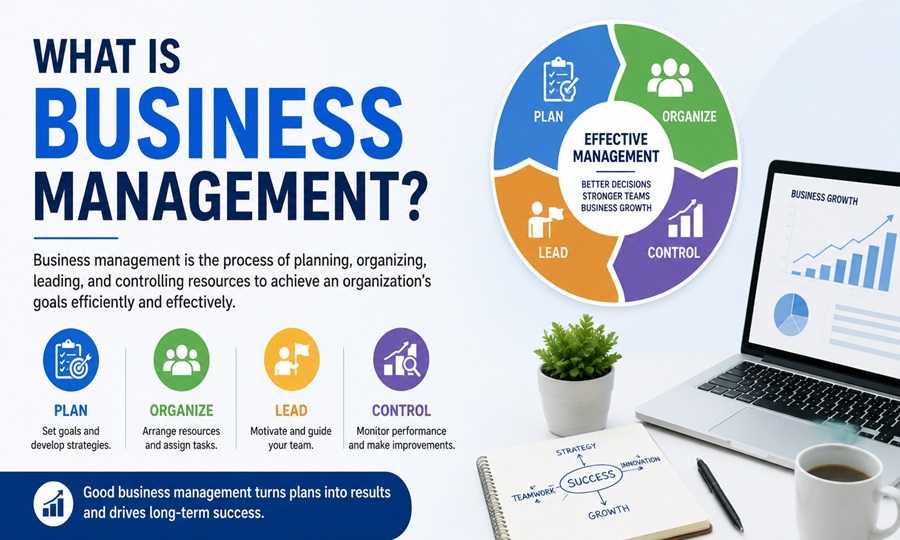
Business management is the coordination of an organization’s resources including people, finances, operations, and information to achieve defined goals. It involves planning what the organization is trying to accomplish, organizing the resources and structures needed to accomplish it, leading the people responsible for execution, and controlling performance against the plan through measurement and adjustment.
Those four functions, planning, organizing, leading, and controlling, represent the classical framework for management that Henri Fayol articulated in the early twentieth century and that subsequent decades of management theory have refined, challenged, and ultimately reaffirmed in most of its essential structure. They remain the most useful organizing framework for understanding what management actually involves, not because they’re complete but because they capture the fundamental activities that every manager performs regardless of industry, organization size, or functional area.
Planning: Where Management Starts
Planning is the management function that determines where the organization is trying to go and how it intends to get there. At the strategic level, planning involves setting the organization’s long-term direction, defining competitive positioning, and allocating resources across the activities that will deliver the strategy. At the operational level, planning translates strategic direction into specific objectives, timelines, budgets, and action plans that guide day-to-day decisions.
Planning is the management function that gets most compressed under operational pressure. When the business is busy, the planning that would improve how it operates gets deferred in favor of handling immediate demands. The consequence of chronic under-investment in planning is an organization that responds to events rather than shaping them, that makes resource allocation decisions without a coherent framework, and that discovers misalignment between what its people are doing and what the business actually needs too late to correct without significant disruption.
Good planning doesn’t require elaborate processes or lengthy documents. It requires honest assessment of where the organization is, clear thinking about where it should go, and the discipline to make explicit decisions about priorities rather than leaving them implicit and therefore subject to conflicting interpretations by different parts of the organization.
Organizing: Building the Structure That Enables Execution
Organizing is the management function that creates the structure through which the plan gets executed. It encompasses how the organization is divided into functions and teams, how authority and accountability are distributed, how work flows between different parts of the organization, and how roles and responsibilities are defined clearly enough that people know what they’re responsible for and who makes which decisions.
Organizational structure is one of those management subjects that gets treated as more permanent than it should be. The structure that made sense for a twenty-person company doesn’t necessarily make sense for a two-hundred-person company. The structure designed for a single-product business creates coordination problems when the business expands into multiple products or markets. Good managers treat structure as a tool for enabling strategy rather than as an inherited constraint that determines what strategies are possible.
The most common structural problems in growing businesses involve spans of control that have expanded beyond what any manager can handle effectively, decision-making authority that hasn’t kept pace with the complexity of decisions being made, and coordination mechanisms that were adequate at smaller scale but produce bottlenecks and conflicts as the organization grows.
Leading: The Human Dimension of Management
Leading is the management function that involves directing, motivating, and influencing people toward the organization’s objectives. It’s the dimension of management that most distinguishes the discipline from pure administration and that most consistently determines whether organizations with adequate strategies and resources actually execute them effectively.
The distinction between management and leadership is one of the most reliably debated topics in management education. The most useful framing is that management is a role with defined responsibilities and formal authority, while leadership is an influence process that can be exercised by anyone regardless of their formal position. Effective managers exercise both, using formal authority where it’s necessary and appropriate while building the trust, credibility, and relationships that allow them to influence people beyond the reach of formal authority.
The specific leadership behaviors that produce organizational performance have been studied extensively, and several findings are consistent enough to be treated as reliable. Clarity about what’s expected and why produces better performance than ambiguity even when the expectations are demanding. Recognition of good work, specific and timely rather than generic and delayed, improves performance and retention. Psychological safety, the belief that it’s safe to speak up, disagree, and take risks without punishment, predicts team performance more reliably than talent alone. Development of people through challenge, feedback, and opportunity builds organizational capability that compounds over time.
Controlling: Closing the Loop Between Plan and Performance
Controlling is the management function that monitors performance against the plan and takes corrective action when the two diverge. It involves establishing performance metrics that reflect what the organization is trying to achieve, measuring actual performance against those metrics with sufficient frequency to intervene before problems compound, analyzing the gap between plan and performance to understand its causes, and adjusting either the plan or the execution based on what the analysis reveals.
The term “controlling” carries authoritarian connotations that don’t reflect what effective management control actually looks like. Controlling in the management sense isn’t surveillance or micromanagement. It’s the feedback loop that allows organizations to learn from experience and improve. An organization without effective control mechanisms operates on faith that the plan is being executed correctly rather than on evidence, and discovers problems after they’ve become expensive rather than before they’ve become costly.
The metrics that constitute effective management control are those that reflect actual outcomes rather than inputs and activities. Revenue, customer satisfaction, quality rates, and unit economics are outcome metrics. Hours worked, reports produced, and meetings attended are activity metrics. Organizations that manage primarily to activity metrics can be extremely busy while moving in the wrong direction, and the control function fails to catch the divergence because the metrics chosen don’t surface it.
Functional Areas of Business Management
Business management operates across several functional areas, each of which represents a distinct domain with its own body of knowledge, skills, and professional practice.
Financial management involves planning, organizing, directing, and controlling the financial activities of the organization. It encompasses budgeting, financial reporting, capital allocation, cost management, cash flow management, and the financial analysis that informs strategic and operational decisions. Financial management skills are foundational to general management because almost every management decision has financial implications that need to be understood before the decision is made.
Operations management addresses how the organization produces its products or services, managing the processes, quality systems, supply chains, and capacity planning that determine the efficiency and reliability of production. In manufacturing businesses, operations management is the core discipline around which everything else is organized. In service businesses, operations management governs service delivery, customer experience, and the systems that make consistent quality possible at scale.
Human resources management covers the full range of activities involved in attracting, developing, managing, and retaining the people the organization depends on. Recruiting, performance management, compensation and benefits, training and development, employee relations, and compliance with employment law all fall within HR management. As labor markets have tightened and the competition for talent has intensified, human resources management has shifted from an administrative function to a strategic one in organizations that recognize their competitive advantage depends primarily on the quality of their people.
Marketing management involves understanding customer needs and market dynamics, developing products and services that address those needs, communicating the organization’s value proposition to target customers, and managing the customer acquisition and retention activities that sustain revenue growth. Marketing management has expanded significantly in scope as digital channels have created new ways to reach and engage customers and new ways to measure the effectiveness of marketing investment.
Strategic management is the function that integrates all other management areas around the organization’s competitive positioning and long-term direction. It involves analyzing the competitive environment, identifying the organization’s distinctive capabilities, making choices about where and how to compete, and allocating resources in ways that build sustainable advantage. Strategic management is the domain where the highest-level management decisions are made and where the consequences of getting those decisions wrong are most severe.
Management Levels and What Each Involves
Business management operates at three distinct levels within most organizations, each with different time horizons, decision types, and skill requirements.
Top-level management, including CEOs, presidents, and executive vice presidents, is responsible for the organization’s overall direction and performance. The decisions made at this level are strategic, with time horizons of years rather than months, and the primary skills required are strategic thinking, external relationship management, stakeholder communication, and the ability to build and lead senior leadership teams. Top-level managers spend most of their time on questions of where the organization should go rather than how to execute current operations.
Middle management translates the strategic direction set by top management into operational plans and manages the functional areas and departments that execute those plans. Middle managers spend their time bridging the gap between strategic intent and operational reality, managing upward to ensure top management has accurate information about what’s happening on the ground and managing downward to ensure their teams have the direction, resources, and support needed to execute effectively.
First-line management, including supervisors and team leaders, is the management level closest to the actual work being done. First-line managers are responsible for the day-to-day performance of their teams, handling the immediate operational issues, coaching and developing team members, and ensuring that the work gets done to the required standard on time. The transition from individual contributor to first-line manager is one of the most significant career transitions in most organizations because it requires a fundamental shift in how value is created, from doing the work oneself to enabling others to do it effectively.
Management as a Discipline vs. Management as a Practice
The academic study of business management through MBA programs and business school curricula provides frameworks, analytical tools, and conceptual models that inform management decision-making. The practical experience of actually managing people, budgets, and operations in real organizations with real constraints develops the judgment, pattern recognition, and interpersonal skills that no classroom can fully replicate.
The most effective managers combine both. They bring conceptual frameworks that help them organize their thinking about complex problems while drawing on accumulated experience that tells them which frameworks apply in which contexts and where the frameworks fail to capture important reality. The gap between management theory and management practice is real, and the most dangerous kind of manager is one who applies theoretical frameworks rigidly without the experiential judgment to know when reality requires a different approach.
What Distinguishes Good Business Management
The qualities that consistently distinguish effective business management from ineffective management show up across organizational contexts regardless of industry, size, or functional area.
Clarity is the most foundational. Effective managers create clarity about what the organization is trying to accomplish, what each person’s role is in accomplishing it, what standards performance is held to, and what decisions have been made versus what remains open. Organizations where these things are clear perform better than those where ambiguity prevails, even when the clear answers are harder to hear than vague reassurance would be.
Accountability without blame creates the conditions where people take ownership of outcomes rather than outcomes without anyone taking responsibility for them. Accountability means that performance is tracked, that falling short of expectations has consequences, and that delivering results is recognized and rewarded. Without it, the planning, organizing, and leading functions produce activity without outcomes. With it, the organization develops a culture where commitments are kept because their seriousness is consistently reinforced.
Adaptability in the face of changing conditions separates organizations that sustain performance over time from those that perform well in the conditions that existed when their strategy was designed and struggle when those conditions change. Good management builds the organizational flexibility to update strategy, structure, and processes as the environment demands rather than defending historical approaches past the point where they remain effective.
The Harvard Business Review has published more rigorously tested research and practitioner insight on business management than any other single source, covering every functional area and management challenge across decades of application in real organizations, making it the most valuable ongoing resource for practicing managers who want to continue developing their capabilities.
The Bottom Line
Business management is both simpler and more complex than its academic treatment often suggests. At its core it’s about getting the right things done through people, at the quality required, within the resources available, on the timelines that matter. The frameworks, tools, and bodies of knowledge that surround that core provide the intellectual structure that makes it possible to do it more reliably and more effectively than intuition alone would allow.
Understanding business management as a practice rather than a subject is what separates people who study it from people who do it, and the gap between those two is closed only through the experience of actually managing, making mistakes, learning from them, and developing over time the judgment that distinguishes genuinely effective management from its imitation.
