

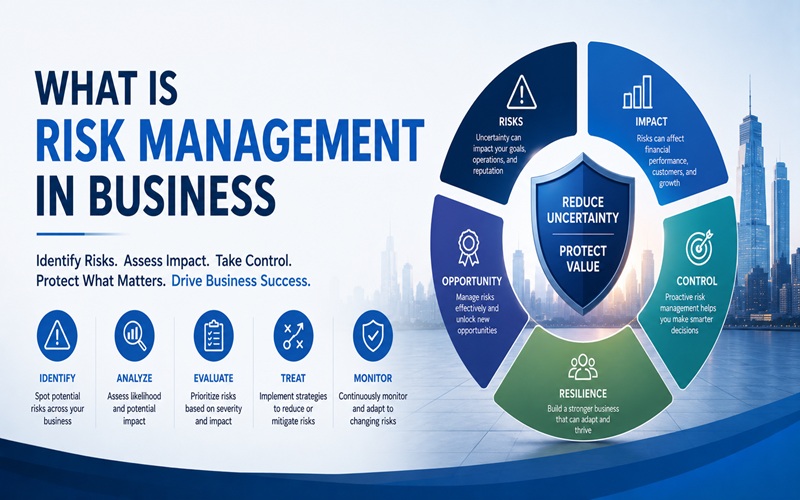
Every business decision involves uncertainty. The supplier might not deliver on time. The market might not respond to the new product as projected. The key employee might leave. The regulatory environment might change. The economic conditions that made a strategy sensible might shift. None of these outcomes is certain, but all of them are possible, and the gap between businesses that navigate uncertainty well and those that don’t is largely determined by how deliberately they manage risk.
Risk management is the discipline through which organizations identify the uncertainties that could affect their objectives, assess their potential impact, and decide how to respond to them in ways that are proportionate to the threat and consistent with the organization’s appetite for risk. It’s not the elimination of risk, which is neither possible nor desirable in a business that needs to take risks to generate returns. It’s the informed, systematic management of risk in ways that protect what matters while preserving the capacity to pursue opportunity.
The Core Definition
Risk management in business is the process of identifying, analyzing, evaluating, and treating risks that could affect an organization’s ability to achieve its objectives. The International Organization for Standardization defines risk as the effect of uncertainty on objectives, which is a deliberately broad definition that encompasses both negative outcomes typically associated with the word risk and the uncertainty inherent in positive opportunities that might not materialize as expected.
This definition encompasses several important implications. Risk exists in relation to objectives, meaning that what constitutes a risk depends on what the organization is trying to achieve. A competitive new entrant into the market is a risk to a company with market share objectives and irrelevant to a company that has deliberately exited that market. Risk involves uncertainty, meaning that both the probability of an event occurring and the severity of its impact are subject to estimation rather than certainty. And risk management addresses the full spectrum from catastrophic threats through to modest uncertainties that deserve attention proportionate to their potential impact.
Why Risk Management Matters
The case for systematic risk management isn’t primarily philosophical. It’s grounded in the observable difference between organizations that manage risk deliberately and those that encounter it reactively.
Organizations that identify and address risks before they materialize avoid the costs of crisis response, regulatory sanction, reputational damage, and operational disruption that unprepared organizations absorb when risks materialize. The cost of prevention is almost always lower than the cost of remediation, and the business that discovers its key supplier is financially unstable through a supply chain review rather than through an unexpected closure has time to develop alternatives that the business learning about the closure from a phone call doesn’t.
Risk management enables better decision-making by making the uncertainty associated with decisions explicit and quantified rather than implicit and ignored. A capital investment decision made with an honest assessment of the market risks, execution risks, and financial risks is a better decision than one made on an optimistic base case that acknowledges no downside. The decision might be the same, but the decision-maker has acted with full information rather than with the partial picture that optimistic planning produces.
Risk management is increasingly required by regulatory frameworks, governance standards, and contractual obligations across most industries. Financial institutions, healthcare organizations, critical infrastructure operators, and publicly listed companies all face specific risk management obligations that make adequate risk management a compliance requirement as well as a business practice. The consequences of inadequate risk management in regulated industries extend beyond business impact to regulatory sanction, license revocation, and personal liability for directors and officers.
The Risk Management Process
Risk management follows a structured process that moves from identification through assessment to treatment and monitoring. Understanding each stage clarifies both the logic of the process and the activities it involves.
Risk Identification
Risk identification is the process of finding, recognizing, and describing risks that could affect the achievement of objectives. It’s both the most important and the most underperformed stage of the risk management process, because risks that aren’t identified can’t be managed.
Effective risk identification draws on multiple sources and perspectives rather than relying on a single view from senior management. Operational staff who perform critical processes have visibility into vulnerabilities and failure modes that leadership doesn’t observe from a distance. Historical incident data reveals the types of risks that have materialized in the past and that are likely to recur. Industry benchmarks and sector risk assessments identify the risks that comparable organizations face. Structured analysis techniques including scenario planning, root cause analysis, and bow-tie analysis reveal risks that aren’t visible through simple experience or observation.
The categories of risk that comprehensive identification covers include strategic risks affecting the organization’s competitive position and direction, operational risks arising from internal processes, systems, and people, financial risks including credit, liquidity, market, and foreign exchange risks, compliance and regulatory risks, reputational risks, environmental and sustainability risks, technology and cybersecurity risks, and people risks including the loss of key talent and workforce capability gaps.
Risk Assessment
Risk assessment evaluates the identified risks in terms of their likelihood and potential impact to determine which require the most urgent and substantial management attention. Two fundamental questions drive the assessment: how likely is this risk to materialize, and how severe would the consequences be if it did?
Qualitative risk assessment uses descriptive scales, typically high, medium, and low for both likelihood and impact, to categorize risks in a risk register and prioritize them for management attention. The output of qualitative assessment, often presented in a risk matrix where likelihood and impact define coordinates, provides an accessible overview of the risk landscape that communicates priorities clearly to non-specialist audiences including boards and senior leadership teams.
Quantitative risk assessment applies numerical probabilities and financial impact estimates to provide a more precise picture of risk exposure that supports financial planning, capital allocation, and insurance decisions. Monte Carlo simulation, value at risk, and expected loss calculations are quantitative techniques that convert risk estimates into financial terms. Quantitative assessment is more resource-intensive than qualitative and most appropriate for significant financial risks where the precision it provides justifies the effort.
Risk appetite is the concept that defines the amount and type of risk an organization is willing to accept in pursuit of its objectives. Risk appetite is not a single number but a framework of statements that express the organization’s tolerance for different types of risk in different contexts. A growth-oriented business might express high appetite for strategic and commercial risks while maintaining very low tolerance for compliance and safety risks. Risk appetite statements translate organizational values and strategy into practical guidance for the decisions that determine the actual risk profile of the business.
Risk Treatment
Risk treatment is the process of selecting and implementing measures to modify risk. It’s where the analytical work of identification and assessment translates into action, and where the choices made determine the actual risk profile of the organization.
Risk avoidance means deciding not to undertake an activity that carries unacceptable risk. A business that declines to enter a market because the political and regulatory risks exceed its appetite for uncertainty is avoiding those risks by foregoing the opportunity. Avoidance is appropriate when the potential impact of the risk exceeds the value of the opportunity and no other treatment option adequately reduces the risk to an acceptable level.
Risk reduction means taking actions that decrease the likelihood of a risk materializing, reduce its impact if it does, or both. Implementing quality controls that reduce the defect rate in manufacturing reduces both the likelihood of a product recall and the potential scale of its impact. Installing cybersecurity controls reduces the likelihood of a data breach and potentially limits the scope of data exposed if a breach occurs. Risk reduction is the most common treatment option and encompasses the full range of operational controls, process improvements, and protective measures that businesses implement.
Risk transfer moves the financial consequences of a risk to another party, typically through insurance or contractual arrangements. Insurance transfers the financial consequences of specified risks to an insurer in exchange for premium payments. Contractual indemnities and warranties transfer risk between contracting parties. Risk transfer doesn’t eliminate the risk or its operational consequences but limits the financial exposure that remains with the organization.
Risk acceptance means acknowledging a risk and deciding to proceed without additional treatment because the cost of treatment exceeds its benefit, the risk is within the organization’s defined appetite, or no effective treatment option exists. Risk acceptance should be a deliberate, documented decision rather than the default that results from failing to address a risk. Accepting a risk means owning the outcome if the risk materializes, and that ownership should be explicit rather than accidental.
Risk Monitoring and Review
Risk monitoring tracks the evolving risk landscape and the effectiveness of treatment measures over time. The risk environment changes as markets evolve, operations change, new threats emerge, and treatment measures produce their intended effects or fail to do so. A risk register that isn’t updated becomes an artifact of historical analysis rather than a current view of the risk landscape.
Monitoring activities include tracking key risk indicators that provide early warning signals when risk levels are changing, reviewing the effectiveness of controls that are supposed to be reducing identified risks, testing the assumptions underlying risk assessments to determine whether they remain valid, and reporting risk information to the appropriate governance levels in a format that enables informed oversight.
Types of Risk in Business
The categories of risk that businesses face are varied enough that a complete risk management program needs to address multiple distinct domains rather than treating risk as a monolithic category.
Strategic risk encompasses the risks to the organization’s competitive position, market relevance, and ability to execute its strategy. Competitive disruption from new entrants with different business models, market shifts that reduce demand for current products, strategic missteps that misallocate resources, and merger and acquisition risks all fall within the strategic category. Strategic risk is often the highest-impact category but the most difficult to treat with conventional control approaches.
Operational risk arises from failures in internal processes, people, systems, and external events that affect operational capability. Process failures, technology outages, human errors, fraud, supply chain disruptions, and the loss of key personnel are all operational risks. Operational risk is typically the category with the most established control infrastructure because its sources are internal and therefore more amenable to management intervention than external strategic risks.
Financial risk encompasses the risks associated with the organization’s financial position and obligations, including credit risk from customers or counterparties defaulting on their obligations, liquidity risk from the inability to meet financial obligations as they fall due, market risk from changes in interest rates, exchange rates, and commodity prices, and capital structure risk from excessive leverage that creates vulnerability to adverse financial conditions.
Compliance risk is the risk of legal or regulatory sanctions, financial penalties, or reputational damage resulting from failure to comply with applicable laws, regulations, and standards. The scope of compliance risk has expanded significantly as regulatory requirements have grown in complexity and enforcement has intensified across most sectors. GDPR, environmental regulations, employment law, financial regulations, and health and safety requirements all create compliance risk that requires systematic management.
Reputational risk is the risk that stakeholder perceptions of the organization will be damaged in ways that affect its commercial relationships, employee engagement, regulatory relationships, and ability to attract capital. Reputational risk often materializes as the consequence of other risk categories, the operational failure that becomes a public crisis, the compliance breach that attracts regulatory action and media attention, or the strategic decision that is seen as prioritizing profit over social responsibility.
Technology and cybersecurity risk has grown in prominence and severity as organizations have become more technology-dependent and as cyber threats have become more sophisticated and more consequential. Data breaches, ransomware attacks, system failures, and technology obsolescence all represent significant risks in the current environment. The intersection of technology risk with operational, financial, compliance, and reputational risk makes it a cross-cutting category that can’t be managed in isolation from the broader risk framework.
People risk encompasses the risks associated with the human capital that organizations depend on, including the loss of key talent, succession gaps in critical roles, skills shortages that limit organizational capability, workforce safety and health, and the human behavior that drives most operational risk events. People risk has grown in prominence as labor markets have become more competitive and the strategic importance of distinctive human capability has increased.
Enterprise Risk Management
Enterprise risk management, commonly abbreviated ERM, represents the most comprehensive approach to business risk management, treating risk as an organizational-wide concern rather than a collection of function-specific programs.
The Committee of Sponsoring Organizations of the Treadway Commission, known as COSO, published the Enterprise Risk Management Integrated Framework in 2004 and updated it in 2017, establishing the most widely referenced standard for ERM in the United States. The ISO 31000 standard provides an internationally recognized framework for risk management principles and guidelines that supports ERM implementation across different organizational contexts.
ERM integrates risk management across all functions and levels of the organization rather than leaving risk identification and management to individual departments. A risk identified in operations that has financial implications, regulatory dimensions, and strategic consequences is managed with visibility across all these dimensions rather than being addressed only in the operational silo where it was identified.
The governance of ERM typically involves a risk committee at the board level with oversight responsibility for the organization’s risk profile and appetite, a Chief Risk Officer or equivalent senior executive with operational responsibility for the ERM program, and risk management professionals embedded within business units who maintain the connection between the enterprise risk framework and the operational realities of specific business areas.
Risk Management for Small Businesses
Enterprise risk management frameworks are designed for large, complex organizations and are disproportionate to the needs and resources of most small businesses. The underlying principles, however, apply regardless of organizational size, and small businesses benefit from a scaled approach to risk management that addresses their most significant risks without the overhead of an enterprise framework.
For a small business, effective risk management starts with the owner honestly identifying the scenarios that could most significantly threaten the business. The loss of the primary customer that represents 60 percent of revenue. The extended illness of the key person whose knowledge and relationships aren’t documented or distributed. The supplier whose financial instability could interrupt supply of a critical input. The regulatory change that could affect the core business model.
For each identified risk, the small business owner assesses the realistic probability and potential impact, considers what treatment options are available and proportionate, and makes explicit decisions about which risks to reduce, transfer through insurance or contracts, or accept. The output doesn’t need to be a formal risk register but should be documented well enough to inform decisions and to ensure that the risks identified receive consistent attention rather than periodic rediscovery.
The Human Dimension of Risk Management
The technical apparatus of risk management, the frameworks, assessments, registers, and controls, exists in an organizational context where human behavior largely determines whether it works. Several behavioral dimensions of risk management deserve explicit attention.
Risk culture, the shared assumptions and norms about how risk information is communicated and how risk decisions are made, is the most powerful determinant of whether formal risk management processes produce genuine risk awareness and informed decision-making. Organizations with healthy risk cultures encourage the surfacing of bad news, reward the identification of risks before they materialize, and treat risk management as a tool for better decision-making rather than a compliance exercise that produces the right documentation.
Cognitive biases including overconfidence, availability bias, and groupthink consistently distort risk assessments in ways that formal processes are designed but often fail to correct. Overconfidence produces probability estimates that understate the likelihood of adverse outcomes. Availability bias inflates the assessed likelihood of risks that have recently been prominent and understates risks that haven’t been salient. Groupthink produces consensus risk assessments that reflect the group’s shared assumptions rather than the actual risk landscape.
The Risk Management Society is the most credible professional organization for risk management practitioners globally, providing educational resources, professional certification through the Fellow of RIMS designation, research publications on emerging risk topics, and a practitioner community that represents the professional reference point for the discipline across industries and organizational contexts.
Risk Management and Business Strategy
The most sophisticated understanding of risk management positions it not as a constraint on business strategy but as an enabler of better strategy and more confident strategic execution.
A business that understands its risk profile can make strategic choices with full awareness of the uncertainty involved and confidence that it has the capability to manage the risks it’s accepting. A business that pursues strategy without systematic risk management is making the same choices with less information, absorbing the same risks with less preparation, and discovering what it didn’t know about its risk exposure in the most expensive possible way.
The organizations that perform best over long periods through changing market conditions are almost invariably those with mature risk management capabilities that allow them to take bold strategic positions with genuine confidence, avoid the catastrophic failures that permanently impair competitive position, and adapt to changing risk environments faster than organizations that are encountering those environments without preparation.
Risk management, at its best, is the organizational discipline that converts uncertainty from a source of anxiety into a source of competitive advantage for the organizations willing to manage it seriously
