

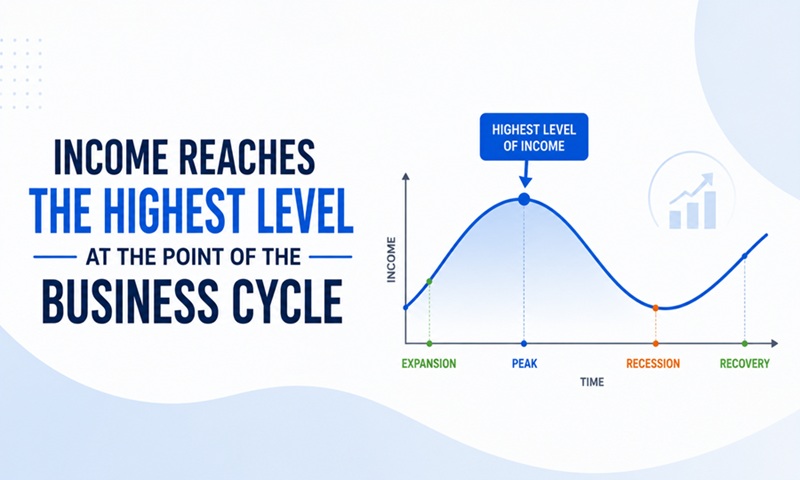
The answer to this question is the peak — the phase of the business cycle at which economic output, employment, and income reach their highest level before the economy begins to contract. Understanding why income peaks at this specific point, what characterizes the peak phase, and what typically follows it is foundational to understanding macroeconomics and has direct practical implications for businesses and investors who need to navigate the cycle rather than simply observe it.
The Business Cycle: A Brief Framework
The business cycle describes the recurring pattern of expansion and contraction in economic activity that characterizes market economies. It has four distinct phases that follow each other in sequence, though the duration and intensity of each phase varies considerably across cycles.
Expansion is the phase during which economic output, employment, consumer spending, and business investment all grow. GDP increases, unemployment falls, and incomes rise as more people are employed and wage growth accelerates in tighter labor markets. Expansions can last for years, and the longest expansion in US economic history ran from June 2009 to February 2020, a period of approximately 128 months.
The peak is the phase at which economic activity reaches its maximum level. At the peak, GDP is at its highest point, unemployment is at its lowest, consumer spending is at its strongest, and income across the economy is at its highest level. The peak represents the top of the cycle before contraction begins.
Contraction, also called recession when it persists for two or more consecutive quarters of declining GDP, is the phase in which economic activity declines from the peak. Output falls, businesses reduce investment and hiring, unemployment rises, and consumer spending contracts as income growth slows or reverses. Contractions can be mild and brief or severe and extended depending on the underlying causes and the policy responses deployed.
The trough is the phase at which economic activity reaches its lowest point before recovery begins. The trough represents the bottom of the cycle, the point at which contraction ends and the next expansion begins. Like the peak, the trough is only identifiable with certainty in retrospect.
Why Income Peaks at the Peak Phase
Income reaching its highest level at the peak isn’t coincidental. It reflects the cumulative effect of the expansion phase on labor market conditions, wage growth, business profitability, and the distribution of economic gains across households.
During the expansion phase, labor markets tighten as businesses increase hiring to meet growing demand. As unemployment falls toward its natural rate and below, the bargaining power of workers increases relative to employers who compete for a shrinking pool of available candidates. This competition for labor drives wage growth, which increases household income across the economy.
Business profitability also peaks near the top of the cycle, as revenues have grown through the expansion while cost structures haven’t yet been fully adjusted to peak operating levels. This profitability supports investment, dividend distributions, and in some cases profit-sharing that further increases income among business owners and shareholders.
The combination of high employment, rising wages, and strong business profitability produces the highest aggregate income levels the economy generates across the cycle. These elevated income levels support the consumer spending that characterizes the peak phase and that, when it begins to moderate, contributes to the transition from peak to contraction.
Characteristics of the Peak Phase
The peak phase has specific economic characteristics that practitioners, policymakers, and business managers can recognize, though they’re easier to identify in retrospect than in real time.
Output and employment at their maximum levels produce the headline economic metrics that characterize a healthy economy. GDP growth, while still positive at the peak, typically begins to slow from the stronger growth rates that characterized the mid-expansion phase. Unemployment may be at or below what economists consider the natural rate of unemployment, the level consistent with stable inflation rather than zero unemployment.
Inflation often accelerates near the peak because the tight labor markets and strong demand that characterize the phase put upward pressure on both wages and prices. The Federal Reserve and other central banks typically respond to inflationary pressure at or near the peak by raising interest rates to cool demand, and it’s often this tightening of monetary policy that contributes to the transition from expansion to contraction.
Consumer confidence and spending are typically at their highest near the peak, reflecting the combination of high employment, income growth, and the accumulated wealth effects of asset prices that have risen through the expansion. These favorable consumer conditions support strong retail sales, housing market activity, and durable goods purchases that characterize peak economic conditions.
Business investment and credit conditions reflect the optimism of the peak phase, with businesses investing in capacity expansion, technology, and workforce development based on expectations that favorable conditions will continue. Credit is typically readily available at competitive terms near the peak, reflecting low default rates and lender confidence in economic conditions.
The Challenge of Identifying the Peak in Real Time
One of the most practically important aspects of the peak phase is that it’s almost impossible to identify with precision while it’s happening. The National Bureau of Economic Research, the official arbiter of US business cycle dates, typically identifies the peak of a cycle only after the recession that follows has already begun, often by six months to a year.
This identification lag exists because the data used to date business cycles is collected and revised over time, and the distinction between a temporary plateau in economic activity and a genuine peak that marks the beginning of a contraction requires more data than is available in real time. The NBER’s Business Cycle Dating Committee applies rigorous analytical standards to a broad range of economic indicators before declaring a cycle peak, and those standards require time to apply.
The practical implication is that businesses, investors, and policymakers who need to position themselves relative to the business cycle must make decisions under uncertainty about where in the cycle the economy actually is. Leading economic indicators including stock prices, building permits, manufacturing orders, and consumer confidence surveys provide forward-looking signals that can inform this assessment, but they’re imperfect predictors rather than reliable forecasts.
How Businesses Should Think About the Peak
For business managers, understanding the peak phase and its implications produces better strategic and financial decisions than treating economic conditions as a fixed backdrop to operating decisions.
Capital allocation decisions made at or near the peak deserve scrutiny that reflects the cyclical nature of the conditions producing current performance. A business that takes on significant debt or makes large capital investments based on peak-level revenues and margins without accounting for the contraction that historically follows is taking risks that the cycle itself will eventually expose. The businesses that navigate contractions most effectively are typically those that maintained financial flexibility through the peak rather than maximizing leverage against favorable current conditions.
Cost structure management at the peak involves resisting the temptation to build fixed costs that are sustainable at peak revenue levels but become burdensome when revenue contracts. Businesses that expand headcount, office space, and overhead infrastructure aggressively at the peak often face difficult restructuring decisions when contraction arrives. Those that maintain leaner cost structures and use variable rather than fixed cost solutions where possible preserve the operational flexibility that contraction requires.
Pricing and margin management at the peak often produce conditions where margins are unusually strong due to the combination of high demand and tight supply. Businesses that recognize this cyclicality invest peak-phase profits in resilience-building rather than distributing them entirely, maintaining reserves that allow the business to sustain operations through the contraction phase without the distress that characterizes businesses that operated as if peak conditions were permanent.
The Relationship Between the Peak and Subsequent Recession
The transition from peak to contraction is rarely a single identifiable event. It’s more commonly a gradual shift in the momentum of economic activity that, in retrospect, can be dated to a specific month but that was experienced at the time as a series of incremental deteriorations in economic conditions.
The mechanisms that typically produce the transition from peak to contraction include monetary policy tightening that raises borrowing costs and reduces the affordability of credit-financed consumption and investment, demand saturation in consumer durables and business investment after a long expansion during which purchases were pulled forward, supply constraints including labor and materials shortages that limit output growth and put upward pressure on costs, external shocks including financial market disruptions, energy price spikes, geopolitical events, and pandemic-type disruptions that abruptly change economic conditions, and financial system vulnerabilities that accumulate during the expansion and are exposed when conditions deteriorate.
No two contractions have exactly the same causes or characteristics, which is part of why identifying the peak in real time is difficult. The mechanisms producing a given contraction are often only clearly visible once the contraction has begun.
Historical Examples of Business Cycle Peaks
Examining historical peaks provides concrete illustrations of the characteristics that theoretical descriptions capture abstractly.
The July 1990 peak followed the longest peacetime expansion in US history to that point and was ended by a combination of monetary policy tightening, the savings and loan crisis, and the economic disruption of the Gulf War. The subsequent contraction was relatively mild and brief, lasting eight months.
The March 2001 peak followed the expansion of the 1990s and the dot-com boom, with the contraction driven primarily by the collapse of the technology investment bubble and the subsequent reduction in business investment. The September 2001 terrorist attacks deepened the contraction, which lasted eight months.
The December 2007 peak preceded the most severe recession since the Great Depression, with the contraction driven by the collapse of the housing market, the exposure of financial system vulnerabilities built up through the expansion, and the subsequent freeze in credit markets that amplified the economic contraction across the entire economy. The recession lasted eighteen months and produced the largest decline in output and employment since the 1930s.
The February 2020 peak ended the longest expansion in US economic history and was followed immediately by the sharpest contraction ever recorded in quarterly terms, driven by the economic disruption of the COVID-19 pandemic. The contraction lasted only two months in calendar terms before the NBER declared the trough in April 2020, making it simultaneously the sharpest and briefest recession in modern US economic history.
The Business Cycle in Academic and Policy Context
The business cycle concept was formalized by the National Bureau of Economic Research, which was founded in 1920 and began its systematic study of business cycles through the work of Wesley Clair Mitchell and Arthur Burns. Their foundational text, Measuring Business Cycles, published in 1946, established the analytical framework that the NBER continues to use in its cycle dating methodology.
Keynesian macroeconomics provided the theoretical framework for understanding why business cycles occur and what policy interventions can moderate their severity. The role of aggregate demand in driving output and employment, the multiplier effects of government spending and taxation, and the potential for economies to remain in prolonged contraction without intervention all informed the activist fiscal policy approach that characterized macroeconomic policy from the mid-twentieth century onward.
The National Bureau of Economic Research Business Cycle Dating Committee is the authoritative source for official US business cycle peak and trough dates, maintaining the historical record of cycle phases back to 1854 and providing the most rigorous publicly available analysis of business cycle chronology and the methodology used to date cycle turning points.
The Practical Takeaway
Income reaching its highest level at the peak of the business cycle is both an empirical regularity and a logical consequence of the dynamics that drive the expansion phase to its natural limit. Understanding this relationship provides a conceptual anchor for interpreting economic data, making financial decisions, and positioning businesses relative to where the economy is in its cycle.
The challenge is that the peak, like the trough, is most clearly visible in the rearview mirror. The practical implication for anyone managing through a business cycle rather than studying it from a distance is to make decisions that are robust across cycle phases rather than optimized for current conditions. Businesses, households, and investors that build resilience during favorable conditions are better positioned to navigate the contraction that historically follows than those that treat the peak as a permanent state rather than a phase in a recurring cycle.
