

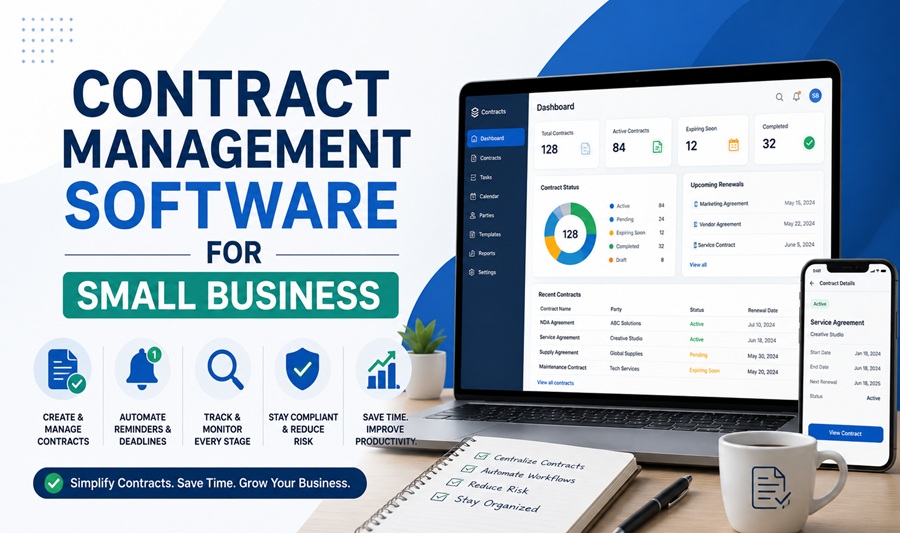
Most small businesses manage contracts the way they manage a lot of administrative work: a folder somewhere, some PDFs in email threads, a mental note about when something renews. It works until a renewal date is missed, a disputed term can’t be located quickly, a client claims the scope was different from what was agreed, or a vendor auto-renews an unfavorable contract for another year because nobody was tracking it.
Contract management software solves these problems with varying degrees of sophistication. The question for most small businesses isn’t whether better contract management would help. It’s whether dedicated software is the right solution relative to simpler alternatives, and if so, which platform fits the actual scope of the problem.
What Contract Management Software Actually Does
Contract management software handles the lifecycle of contracts from creation through signature to storage, tracking, and renewal management. The specific capabilities vary considerably between platforms, but the core functions cover a consistent set of needs.
Contract creation tools provide templates, clause libraries, and document assembly features that reduce the time required to draft standard agreements. Instead of starting from a blank document or copying from a previous contract and editing, users select a template, fill in the relevant variables, and produce a draft that reflects the business’s standard terms. For businesses that issue the same types of contracts repeatedly, this standardization reduces both drafting time and the inconsistency that accumulates when each contract is drafted individually.
Electronic signature integration allows contracts to be sent, signed, and returned without printing, scanning, or physical exchange. E-signature is now legally valid for most business contracts in the US under the ESIGN Act and in the UK and Europe under eIDAS regulations, with limited exceptions for specific document types including certain real estate transactions and court filings. Most contract management platforms include e-signature natively or integrate with dedicated e-signature tools including DocuSign and Adobe Sign.
Contract repository and search functionality provides centralized storage for all executed contracts with metadata tagging and full-text search. Instead of contracts living in email attachments, shared drives, and filing cabinets across multiple locations, a contract repository creates a single searchable location where any contract can be found by party name, contract type, date, or any term within the document.
Obligation tracking and alerts monitor key dates including expiration dates, renewal windows, payment obligations, and milestone deadlines, generating notifications before these dates arrive rather than after they’ve passed. Missing a contract renewal window, as discussed above, is one of the most common and costly contract management failures, and automated alerts eliminate it as a risk.
Approval workflows route contracts through the appropriate internal review and sign-off steps before execution. For businesses where contracts above certain values require management approval, legal review, or finance sign-off, workflow automation ensures these steps happen consistently without relying on manual process adherence.
Reporting and analytics provide visibility into the contract portfolio as a whole. How many active contracts are in place? What is the total contracted revenue or committed spend? Which contracts expire in the next 90 days? How long does contract execution typically take from draft to signature? These questions are impossible to answer without a managed contract repository and difficult to answer accurately even with one that lacks reporting functionality.
Who Actually Needs Dedicated Contract Management Software
Small businesses fall into genuinely different categories when it comes to contract management needs, and the right answer isn’t the same for all of them.
Businesses that issue or receive a high volume of similar contracts benefit most clearly from dedicated contract management software. A staffing agency, a marketing agency, a software company with subscription agreements, or a construction firm with subcontractor agreements all handle contract volumes where manual management creates real risk and real time cost. Standardizing these contracts through templates and managing their lifecycle through software produces measurable efficiency and risk reduction.
Businesses with significant renewal-sensitive contracts need the tracking and alert functionality that basic file storage doesn’t provide. SaaS companies managing customer subscription agreements, businesses with vendor contracts that auto-renew, and any organization where missing a renewal window has meaningful financial consequences justify the investment in tracking functionality alone.
Businesses in regulated industries including healthcare, financial services, and government contracting face compliance requirements around contract documentation, retention, and audit trails that make unmanaged contract storage inadequate regardless of volume.
Businesses with limited contract volume and simple contract types may not need dedicated software. A freelancer who signs five client agreements per year, a retailer with a handful of supplier agreements, or a service business whose contracts are simple one-page engagements can manage effectively with organized cloud storage, a basic tracking spreadsheet, and calendar reminders for key dates. The administrative overhead of implementing and maintaining contract management software should be proportionate to the contract management problem being solved.
The Main Platforms and What Each Does Best
The contract management software market spans from simple e-signature tools with basic storage to sophisticated enterprise CLM platforms. The platforms most relevant to small businesses sit in the middle of that range, providing meaningful contract lifecycle management without the complexity and cost of enterprise systems.
PandaDoc
PandaDoc combines document creation, e-signature, and contract management in a platform designed for sales-driven businesses. Its template library, drag-and-drop document builder, and integrated payment collection make it particularly strong for businesses that send proposals and contracts as part of a sales process. The analytics that show when recipients open and read documents provide useful sales intelligence alongside the contract management functionality. Pricing starts at $19 per user per month for the Essentials plan and runs to $49 per user per month for Business, which includes approval workflows and a CRM integration library.
DocuSign CLM
DocuSign is the most widely recognized e-signature platform, and its CLM product extends beyond signature to contract lifecycle management including contract creation, negotiation, and repository. For businesses where counterparties are already familiar with DocuSign’s signature experience, the brand recognition reduces friction in the signing process. The CLM capabilities are more sophisticated than simple e-signature needs require, positioning it toward businesses with genuine contract lifecycle management requirements rather than those primarily seeking e-signature functionality. Pricing for the full CLM product is enterprise-oriented and requires direct engagement with DocuSign’s sales team.
Ironclad
Ironclad is a purpose-built contract lifecycle management platform with strong workflow automation, redlining and negotiation functionality, and a powerful contract repository with AI-assisted search and data extraction. Its AI capabilities that automatically extract key terms, dates, and obligations from uploaded contracts reduce the data entry burden of building a contract repository from existing agreements. Ironclad targets mid-market and enterprise customers rather than very small businesses, with pricing that reflects that positioning. For small businesses that have grown to the point where a genuine CLM platform is appropriate, Ironclad is among the strongest options.
Contractbook
Contractbook is designed specifically for small and mid-sized businesses, combining contract creation, e-signature, and lifecycle management with a clean interface and pricing that reflects small business budgets. Its template library, automated data extraction from signed contracts, and integration with tools including HubSpot, Slack, and Google Drive make it a functional end-to-end contract management solution for businesses that need more than basic e-signature but aren’t ready for enterprise CLM pricing. Pricing starts at $115 per month for small teams.
HelloSign (now Dropbox Sign)
Dropbox Sign, formerly HelloSign, provides straightforward e-signature functionality with basic document management at competitive pricing. It’s appropriate for businesses whose primary need is reliable e-signature rather than full contract lifecycle management. Its deep integration with Dropbox and Google Drive makes it a natural choice for businesses already standardized on either ecosystem. Pricing starts at $15 per user per month.
SpotDraft
SpotDraft has built a strong position in the mid-market with AI-powered contract review, risk scoring, and obligation tracking alongside standard CLM functionality. Its AI contract review capability, which identifies potentially unfavorable terms and flags deviations from standard templates, is particularly valuable for businesses that regularly review contracts from counterparties rather than only issuing their own standard agreements. Pricing is available on request and scales with organization size.
Adobe Acrobat Sign
Adobe Acrobat Sign provides e-signature functionality integrated with the Adobe document ecosystem. For businesses already using Adobe Creative Cloud or Acrobat for document management, the integration is seamless and the familiar interface reduces adoption friction. It’s primarily an e-signature tool with document management rather than a full CLM platform, positioning it for businesses whose needs don’t extend to full lifecycle management.
The Build vs. Buy Decision for Simple Needs
Before investing in dedicated contract management software, it’s worth honestly assessing whether a structured approach using existing tools addresses the actual problem.
A shared folder structure in Google Drive or SharePoint with consistent naming conventions, a Google Sheet tracking key contract terms and dates, and calendar reminders for renewal windows handles the contract management needs of many small businesses without any additional software cost or implementation effort. The limitation is that it requires manual maintenance discipline and lacks the automation that prevents the tracking from falling behind.
DocuSign or Adobe Sign as standalone e-signature tools, without the CLM platform, addresses the signature friction problem for businesses whose primary pain point is the paper-based signing process rather than contract lifecycle management broadly. At $10 to $15 per user per month for basic tiers, the cost is low and the implementation is simple.
The case for dedicated contract management software becomes clear when the manual approach has demonstrably failed, when contract volume is high enough that manual tracking is genuinely burdensome, when compliance requirements mandate more rigorous documentation, or when the cost of missed renewals or disputed terms has already been significant enough to justify prevention.
Implementation Considerations
Contract management software implementations fail for predictable reasons that are worth addressing before starting rather than discovering after.
Template development is the upfront investment that determines how much value the platform delivers. Platforms with contract creation capability are only as good as the templates built within them. Investing time in creating high-quality templates that reflect the business’s actual standard terms, reviewed by legal counsel where appropriate, produces a library that reduces drafting time and improves consistency. Generic templates that don’t reflect the specific business’s requirements provide limited value over starting from scratch each time.
Data migration from existing contract storage into the new repository requires deciding which historical contracts to migrate, extracting metadata from those contracts, and uploading them with appropriate tagging. For businesses with large existing contract portfolios, this migration is a significant project that deserves dedicated time. AI-assisted data extraction capabilities in platforms including Ironclad and SpotDraft reduce but don’t eliminate this effort.
Adoption requires that everyone in the organization who creates or manages contracts actually uses the new system rather than falling back to email attachments and shared drives. Clear internal policies about where contracts are stored and signed, combined with workflows that route contracts through the platform by design rather than by choice, produce adoption that holds over time.
Integration with existing systems including the CRM, the accounting platform, and the project management tool determines how much manual data re-entry the contract management system requires. Platforms with strong integration libraries including PandaDoc and Contractbook reduce the friction of adding contract management to an existing technology stack.
Pricing Summary
Contract management software pricing ranges widely enough that budget planning benefits from understanding the tiers.
Basic e-signature tools including Dropbox Sign and Adobe Acrobat Sign start at $10 to $15 per user per month and provide signature functionality with basic document storage.
Mid-market contract management platforms including PandaDoc and Contractbook start at $15 to $50 per user per month for plans that include templates, workflows, and repository functionality suitable for most small business needs.
Full CLM platforms including Ironclad and SpotDraft are priced for mid-market and enterprise organizations and typically require direct engagement with sales teams for pricing, with contracts often starting at several hundred to several thousand dollars per month depending on organization size and feature requirements.
Enterprise CLM platforms including DocuSign CLM, Icertis, and Agiloft serve large organizations with complex contract portfolios and are priced accordingly, with annual contracts typically running into five or six figures.
The World Commerce and Contracting Association is the most credible professional body focused on contract management practices globally, publishing research on contract management maturity, technology adoption, and the measurable business impact of effective contract management that provides useful context for evaluating the investment case for contract management software.
The Practical Decision Framework
The decision framework for small businesses evaluating contract management software runs through three questions in sequence.
Is the current approach to contract management causing measurable problems? Missed renewals, disputed terms, difficulty finding contracts, inconsistent agreement language, or slow execution cycles all represent measurable problems that software can address.
Is the problem significant enough to justify software investment? The cost of the software plus the implementation time needs to be proportionate to the cost of the problem being solved. A business that signs three contracts per year and has never missed a renewal doesn’t have a contract management problem worth solving with software.
Does the problem require a full CLM platform or would simpler tools address it? Many small business contract management problems are solved by e-signature functionality plus organized cloud storage plus calendar reminders, without requiring dedicated contract lifecycle management software.
Businesses that answer yes to all three questions have a clear case for evaluating dedicated contract management platforms. Those that answer yes to the first but no to the second or third are better served by improving their existing approach rather than adding software complexity.
