

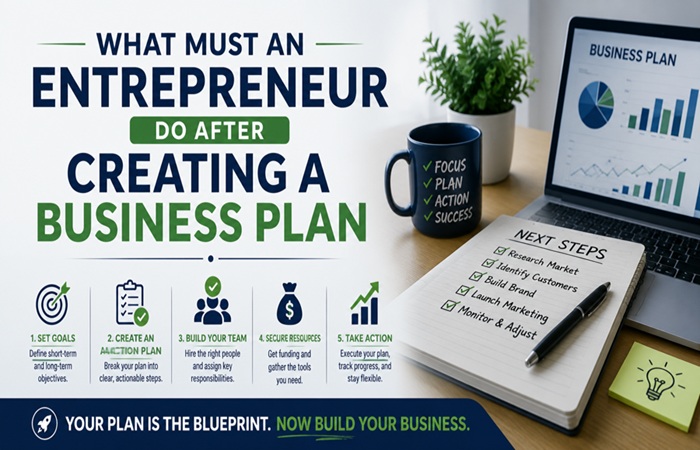
Finishing a business plan feels like a significant achievement, and it is. The research, the financial projections, the competitive analysis, the operational framework — pulling all of that into a coherent document takes real work. But here is the thing most first-time entrepreneurs discover fairly quickly: a business plan sitting on a desk or saved in a folder does absolutely nothing on its own. The plan is not the destination. It is the starting line.
The transition from planning to execution is where most entrepreneurial journeys either gain traction or quietly stall out. According to CB Insights research, 42 percent of startups fail because of a lack of product market fit, meaning they built something the market did not actually want in the way they assumed it would. That statistic is a direct consequence of skipping or rushing the steps that should follow a business plan. Here is a practical, ordered breakdown of what comes next.
Step One: Validate Your Assumptions Before Spending Serious Money
A business plan is built on assumptions. Market size estimates, customer behavior predictions, pricing models, competitive positioning — every one of those elements is a hypothesis until real-world data confirms or challenges it. The most costly mistake an entrepreneur can make after completing a plan is treating those assumptions as facts and investing heavily before testing them.
Market validation does not need to be expensive or time-consuming. The goal is to put the core value proposition in front of real potential customers as quickly and cheaply as possible and observe their actual behavior rather than their stated opinions. A minimum viable product, a landing page that collects email signups, a pilot offering to a small group, or even direct conversations with people who match your target customer profile can reveal whether the fundamental premise of your business resonates before you have committed significant capital to it.
The question you are trying to answer at this stage is not whether people say they like your idea. It is whether they are willing to pay for it, recommend it, or change their behavior to use it. The gap between what people say and what they do is where many businesses find themselves in trouble. Validate with actions, not opinions.
Step Two: Handle the Legal Foundation
Once you have enough evidence that your core concept is viable, establishing the legal structure of the business is a non-negotiable priority. Operating without proper legal formation exposes you to personal liability, makes it impossible to open a business bank account, prevents you from hiring employees properly, and complicates any future fundraising.
The most common structures for new businesses are sole proprietorships, limited liability companies, and corporations. LLCs are particularly popular among small and medium businesses because they provide personal liability protection while remaining relatively simple to operate and maintain. Corporations, particularly S-corps and C-corps, are generally the preferred structure for businesses planning to raise outside investment or issue equity to employees.
Beyond the entity structure itself, the legal foundation includes registering your business name with the appropriate state division, obtaining any required business licenses or permits for your industry, applying for an Employer Identification Number from the IRS, and opening a dedicated business bank account. Keeping business and personal finances separated from day one is one of the most important habits a new entrepreneur can establish.
Depending on your industry and business model, you may also need to address intellectual property protection at this stage. If your business is built on a proprietary product name, a unique brand, original creative work, or a novel process, consulting with an attorney about trademark registration or other IP protections early prevents far more expensive problems later.
Step Three: Secure Funding Aligned With Your Stage and Structure
With validation evidence in hand and a legal entity established, the question of funding becomes concrete rather than theoretical. Your business plan’s financial projections now serve their most important practical purpose: helping you make the case to potential capital sources that your business is worth backing.
As the U.S. Small Business Administration’s guide to funding your business outlines, the right funding source depends heavily on how much capital you need, what stage your business is at, and how much equity or control you are willing to give up. Personal savings and bootstrapping remain the most common starting point for early-stage entrepreneurs, and they carry the significant advantage of preserving full ownership and avoiding the pressure of investor timelines. Friends and family funding is another common early stage source, though it carries relational risks that deserve careful thought.
Small business loans, SBA-backed loans, and lines of credit from banks and credit unions are viable options for businesses with at least some operational history and a clear revenue model. Angel investors and venture capital become relevant when a business has a validated high-growth model that can justify equity investment in exchange for capital. Crowdfunding platforms offer another pathway, particularly for consumer-facing products with broad appeal.
Whatever funding path you pursue, your business plan and early validation data are the foundation of every conversation with capital sources. Investors and lenders want to see that your assumptions have been tested and that someone other than you believes the business has real potential.
Step Four: Build Your Core Team
Very few businesses succeed with a single founder carrying every function. The research is clear on this: startups with cofounders are significantly more likely to succeed than those run by solo founders, and 23 percent of startups cite a lack of the right team as a contributing factor in their failure according to CB Insights data.
Building a core team does not necessarily mean hiring full-time employees from day one. For early-stage businesses with limited capital, it might mean identifying two or three people whose skills complement your own and who are willing to join as cofounders, advisors, or early hires at below-market compensation in exchange for equity or upside participation. What matters at this stage is identifying the critical functional gaps in your own skill set and filling them with people whose capabilities and work ethic you trust.
The most common gaps for first-time entrepreneurs tend to be in technology, sales, and financial management. If you are a product-oriented founder, you almost certainly need someone with genuine sales and go-to-market experience. If you are a sales-oriented founder, you likely need someone who can build and maintain the operational and financial infrastructure of a growing company.
Step Five: Develop Your Brand and Go-to-Market Strategy
A validated concept and a legal entity give you the infrastructure to operate. A brand and a go-to-market strategy give you the means to grow. These are not the same thing, and they deserve separate attention.
Your brand is more than a logo and a color palette. It is the sum of how your business communicates its value, its personality, and its promise to customers across every touchpoint. Investing in clear, consistent brand positioning early makes every subsequent marketing effort more efficient because you are not rebuilding the message from scratch each time.
Your go-to-market strategy is the practical plan for how you will reach your target customers, convert them to buyers, and retain them long enough to generate meaningful revenue. Poor marketing strategy is cited as a cause of failure in 22 to 29 percent of startup post-mortems, making it one of the most consistently underestimated challenges new entrepreneurs face. The most effective early go-to-market approaches tend to be highly focused rather than broadly distributed, targeting the specific channels where your best-fit customers actually spend their attention rather than trying to be everywhere at once.
Step Six: Set Up Operations and Financial Tracking
Getting the operational and financial infrastructure in place before revenue scales is far easier than trying to retrofit it after the fact. This includes establishing the tools and systems you will use to deliver your product or service consistently, tracking your finances in real time, managing customer relationships, and monitoring the key performance indicators that signal whether your business is on track.
One of the most important disciplines for any new business is maintaining clean financial records from the first transaction. Understanding your actual costs, your revenue per customer, your gross margins, and your cash burn rate on a monthly basis is not optional. Running out of cash is the single most common cause of startup failure, accounting for 38 to 40 percent of business deaths between 2022 and 2025. That rarely happens without warning if a founder is tracking the right numbers closely.
The Business Plan Is a Living Document, Not a Final Answer
After working through validation, legal formation, funding, team building, brand development, and operational setup, the final thing every entrepreneur must internalize is that the business plan they created is not the last word. It is the first draft of a strategy that will change as you learn more about your customers, your market, and your own capabilities.
The most successful entrepreneurs treat their business plan as a dynamic reference point they return to regularly, update when new information challenges their assumptions, and use as a measuring stick for whether execution is matching intention. The ones who fail most preventably are those who either never make the leap from planning to action, or who make that leap without ever testing whether the plan reflects reality.
The plan gives you direction. Execution, adaptation, and a willingness to learn from what the market actually tells you are what builds the business.
